How Transparent Is Crypto.com’s Proof Of Reserves? New Questions Emerge
English originalView translation
Reading sizeRead report ↓
Loading image
Key takeaways Galaxy Digital’s Alex Thorn reportedly questioned why Crypto.com still points customers to a proof-of-reserves report from December 2022. The Mazars report covered nine assets as of December 7, 2022, showing reserve ratios of 102% for BTC, 101% for ETH and 106% for USDT. It was an agreed-upon procedures engagement, not a full audit, […]

• Galaxy Digital’s Alex Thorn reportedly questioned why Crypto.com still points customers to a proof-of-reserves report from December 2022.
• The Mazars report covered nine assets as of December 7, 2022, showing reserve ratios of 102% for BTC, 101% for ETH and 106% for USDT.
• It was an agreed-upon procedures engagement, not a full audit, and says nothing about balances after that date.
• Crypto.com publishes some wallet addresses and a CDCBTC reserve dashboard, but neither reconciles the exchange’s total customer liabilities.
• The report’s age does not show a shortfall, but it leaves open when Crypto.com will publish a new independent assessment.
Crypto.com is facing renewed questions over its reserve disclosures after Galaxy Digital’s head of research, Alex Thorn, reportedly questioned why the cryptocurrency exchange still refers customers to a verification conducted in December 2022.
Thorn raised the issue on Sunday, drawing attention to the age of the exchange’s publicly available proof-of-reserves report. Reserve transparency has remained a point of debate across the industry since the collapse of FTX, with exchanges such as Binance introducing regular proof-of-reserves disclosures to address customer concerns.
A review of Crypto.com’s reserve verification confirms that the company continues to reference the same historical assessment. However, the exchange also makes certain wallet holdings publicly available and operates a separate reserve dashboard for one of its products.
The distinction raises a broader question for customers: how much can they independently verify about the assets held on their behalf today?
What Crypto.com’s 2022 Reserve Report Actually Shows
The original report, prepared by Mazars and dated December 9, 2022, examined the exchange’s holdings against corresponding customer liabilities as of December 7 that year.
Nine cryptocurrencies were included in the assessment, among them Bitcoin, Ethereum, XRP, Dogecoin and the stablecoins USDT and USDC.
Mazars reported reserve ratios of 102% for Bitcoin, 101% for Ethereum and 106% for USDT at the time of verification.
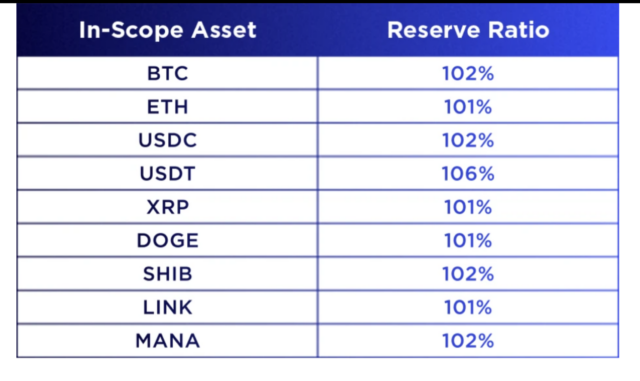
Reserve ratios reported by Mazars based on Crypto.com’s holdings and corresponding customer liabilities as of December 7, 2022. Source: Crypto.com.
The report also contains an important limitation. Mazars conducted an agreed-upon procedures engagement rather than a full financial audit. Its findings did not extend to balances or transactions after the reporting date.
Crypto.com used a cryptographic verification method known as a Merkle tree, allowing eligible customers to establish whether their balances were included in the assessment without publicly exposing individual account information.

Crypto.com’s illustration of the Merkle Tree structure used to verify customer balances included in its proof-of-reserves assessment. Source: Crypto.com.
That process can help customers verify their inclusion in a particular snapshot. It cannot establish that the same reserve ratios remain in place nearly four years later.
Crypto.com Has Newer Reserve Data, But Its Scope Is Different
The exchange maintains that customer funds are fully backed and available for redemption. It has also published key wallet addresses through its reserve transparency page.
Separately, Crypto.com operates a proof-of-reserves dashboard for CDCBTC, its wrapped Bitcoin token.
The dashboard compares the amount of CDCBTC in circulation with the Bitcoin held to support it. Unlike the historical Mazars report, it displays more recent reserve information.
However, verifying the backing of a wrapped token is different from reconciling the customer liabilities of an entire cryptocurrency exchange.
Public wallet balances can show how much cryptocurrency is held at disclosed addresses. Without a corresponding assessment of what the company owes customers, those balances alone cannot establish the adequacy of its overall reserves.
Other exchanges have taken a recurring approach to reserve verification. Kraken’s proof-of-reserves, for example, lists a reporting date of September 30, 2026.
Reserve disclosures referenced in this article and what each one can show. Source: Crypto.com, Mazars, Kraken; Bitcoinist analysis.
The comparison does not establish that one exchange is financially stronger than another. It does illustrate how frequently customers can access updated reserve assessments.
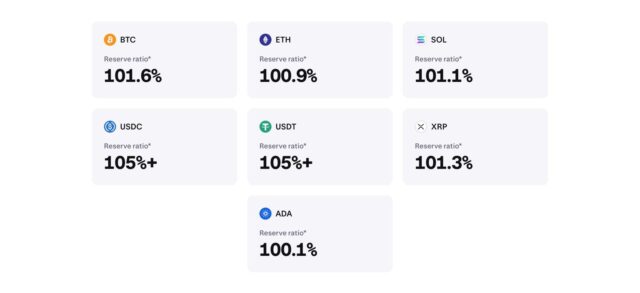
Kraken’s reported reserve ratios as of March 31, 2026, following verification by The Network Firm. Source: Payward.
Why The Reporting Date Matters
The Public Company Accounting Oversight Board warned investors in 2023 against treating proof-of-reserves reports as substitutes for financial audits.
Such assessments have limitations even when recently published. Their usefulness depends on the assets and liabilities examined, the procedures performed and the date of verification.
Thorn’s reported criticism does not establish that Crypto.com has a reserve shortfall. The age of its publicly linked Mazars assessment is nevertheless a legitimate transparency question.
What remains unanswered is whether Crypto.com intends to publish a new independent assessment of its broader customer liabilities and corresponding reserves, and when customers can expect to see it.