









Injective Urges SEC to Open Tokenized Stock Trading to Order Books
英語の原文翻訳を見る
文字サイズ本文を読む ↓
画像を読み込み中
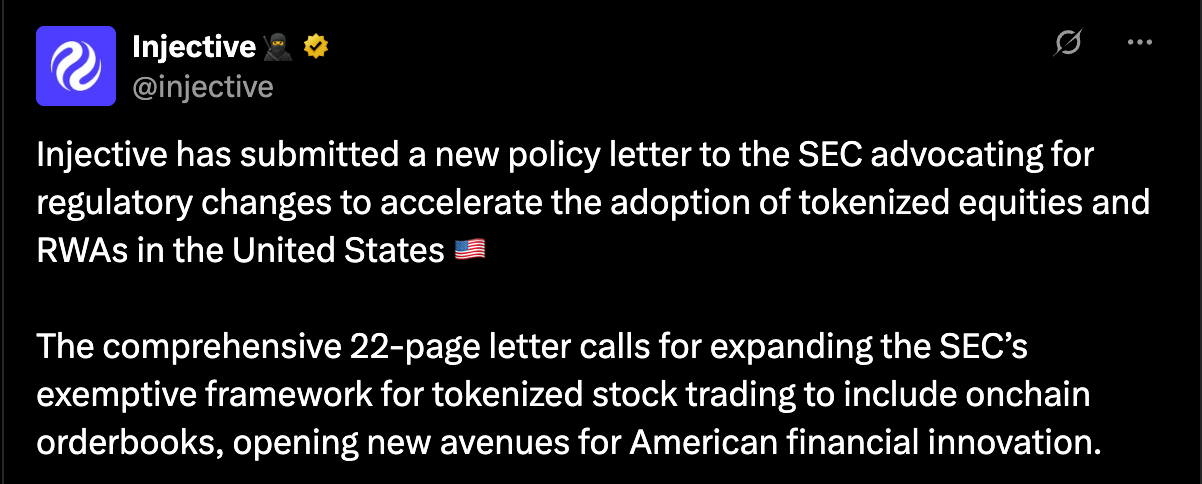
Injective has urged the U.S. SEC to expand its tokenized stock trading exemptions to include on-chain order books.
Key Takeaways
• Injective’s third SEC submission seeks tokenized stock exemptions for on-chain order books.
• The proposal includes safeguards against market manipulation and front-running.
• SEC approval could expand competition and improve onchain price discovery.
Injective Challenges SEC Rules Favoring Crypto Liquidity Pools
Injective is challenging a key limitation in U.S. crypto regulation, arguing that blockchain-based stock exchanges should receive equal treatment regardless of how they match trades.
In a 22-page policy letter dated Nov. 23, Injective Labs asked the Securities and Exchange Commission (SEC) to extend its exemption for tokenized equities to onchain order books, the trading model underpinning traditional stock markets.
The SEC’s existing five-year exemption, introduced in September, permits qualifying tokenized stock trading through automated market makers (AMMs) and liquidity pools. Order book-based platforms remain excluded.
Injective argues that this distinction could restrict competition as financial institutions increasingly explore blockchain-based securities trading.
Source: Injective
Injective Challenges SEC’s Tokenized Stock Trading Restrictions
The company contends that onchain orderbooks offer the same fundamental benefits that persuaded regulators to approve exemptions for AMMs.
These include round-the-clock trading, self-custody, near-instant settlement, and publicly verifiable transactions.
In its submission, Injective argued that “the exemption should turn on the characteristics and safeguards of the onchain venue,” rather than its trading mechanism.
Orderbooks also display bids, offers, and available liquidity, potentially improving price discovery and helping tokenized stock prices remain aligned with conventional markets.
Unlike AMMs, they do not require separate liquidity pools, potentially reducing certain risks for retail liquidity providers.
Investor Protections Take Center Stage in Third SEC Appeal
Injective proposed additional safeguards to address concerns about manipulation and market integrity. These include mandatory market surveillance, self-trade prevention, price limits, and protocol-level trading halts.
The company also highlighted its frequent batch auction mechanism, which can reduce front-running and maximum extractable value (MEV) risks by processing eligible orders under predetermined matching rules.
The latest letter marks Injective’s third formal policy submission to the SEC, following earlier recommendations concerning decentralized finance and onchain lending. Injective is seeking broader regulatory changes rather than an exemption exclusively for its own blockchain.
The outcome could influence how U.S. investors access tokenized equities and how crypto platforms compete to bring traditional financial markets onchain.
For now, the SEC has yet to approve the proposed expansion.