Solo Bitcoin Miner Wins $190K Jackpot Against 130 Million-to-One Odds
英文原文查看译文
阅读字号阅读正文 ↓
加载图片中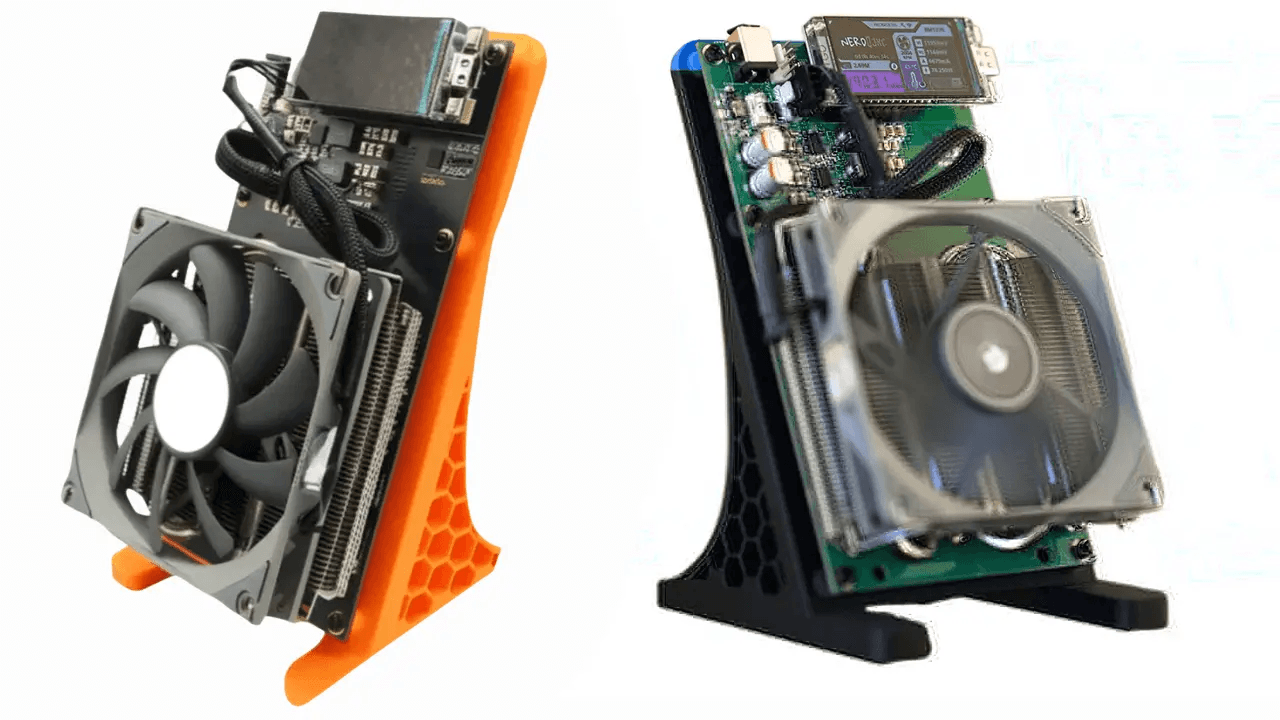
A solo bitcoin miner operating with just 8 TH/s of computing power struck a roughly $190,000 jackpot on Sunday, Nov. 22, 2026, joining a growing procession of unlikely winners as the bitcoin mining industry confronts punishing economics and depressed digital asset prices. A $190,000 Bitcoin Jackpot With Astronomical Odds Imagine purchasing a lottery ticket with […]
Key Takeaways
• Solo bitcoin miners have recorded dozens of successful block discoveries throughout 2026, including several victories involving relatively inexpensive equipment.
• Bitcoin’s hashrate has reclaimed the 1 ZH/s threshold despite declining mining revenue and mounting operational pressures.
• Small-scale miners continue chasing full block rewards, even when electricity expenses exceed their expected daily earnings.
A $190,000 Bitcoin Jackpot With Astronomical Odds
Imagine purchasing a lottery ticket with odds so improbable that mathematics suggests waiting more than 2,000 years for a winning result. Now imagine beating those odds on an otherwise ordinary Sunday morning.
That is essentially what happened on Nov. 22, when an unidentified solo bitcoin miner discovered block height 977057 through CKPool Solo at approximately 7:54 a.m. Eastern time.
The fortunate participant collected 3.1287 BTC, comprising the standard 3.125 BTC block subsidy and approximately 0.0037 BTC in transaction fees. With bitcoin’s price trading near $60,700 at 10 a.m. Eastern time, the reward carries an estimated value of $190,000 before the mining service’s fee.
The block contained 584 transactions and arrived just 3.3 minutes after its predecessor. Yet the most extraordinary detail concerns the relatively modest computing equipment responsible for the discovery.
According to the mining data logged by soloblocks.io, the winner commanded approximately 8 terahash per second (TH/s), equivalent to the combined output of roughly seven Bitaxe Gamma devices.
Against Bitcoin’s current network hashrate of 1,042 exahash per second (EH/s), that represents an almost imperceptible fraction of the computational power competing to discover the next block. The miner’s estimated probability of finding any particular block was approximately one in 130 million. At that hashrate, the statistically expected waiting period stretched roughly 2,500 years.
Instead, the miner struck gold. The winner’s identity remains unknown, but like all the solo blocks discovered before it, the reward is recorded on Bitcoin’s public blockchain. It’s basically another example of how a relatively small participant can occasionally overcome the enormous computational advantage enjoyed by industrial mining operations.
Solo Bitcoin Miners Are Enjoying an Extraordinary 2026
Sunday’s discovery was hardly an isolated incident. Throughout 2026, solo miners have repeatedly captured entire block rewards, occasionally using equipment that would appear almost insignificant beside commercial mining facilities.
Bitcoin.com News previously documented 36 solo-style block discoveries between Feb. 11 and Nov. 7, collectively generating approximately 113 BTC in rewards, valued near $8.5 million at prevailing prices. November has been especially active.
CKPool Solo participants discovered two blocks on Nov. 7, followed by additional victories on Nov. 11 and Nov. 19. Sunday’s discovery marked the fifth reported CKPool Solo block during November alone.
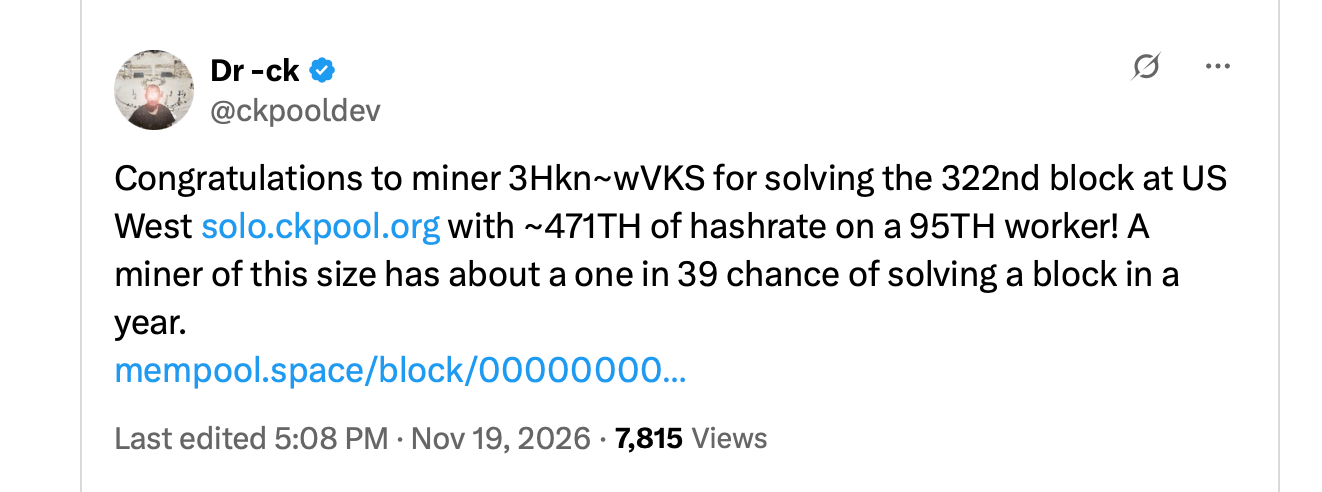
CKPool Solo operator and developer Con Kolivas discussing block height 976642 on X, which was mined just a few days ago on Nov. 19, 2026.
One Nov. 11 winner operated with approximately 161 TH/s, while another participant in July reportedly discovered block 957382 using a single Bitaxe generating around 1 TH/s through Public Pool. According to Soloblocks.io’s historical tracking, the latest discovery brought the documented total to 146 solo-style blocks since 2016, representing more than 1,000 BTC in cumulative rewards.
However, these successes should not be mistaken for improving individual probabilities. The more miners participating, the greater the opportunity for occasional improbable victories across the entire group. For any particular machine, the mathematical odds remain unforgiving.
Bitcoin Mining Economics Make the Jackpot Even Sweeter
These victories arrive during one of the industry’s more financially demanding periods. On Saturday, Nov. 21, bitcoin slipped to $55,081 on Bitstamp, while hashprice deteriorated to $26.16 per petahash per second (PH/s) per day. Bitcoin’s network hashrate, nevertheless, has recovered above 1 zettahash per second (ZH/s), despite the considerable financial pressure confronting commercial operators.
For smaller participants, the economics are particularly discouraging. A miner operating 8 TH/s could expect approximately 21 cents in gross daily revenue under the supplied network conditions. Electricity expenses for a comparable setup drawing 100 to 200 watts could range from 24 to 48 cents daily at $0.10 per kilowatt-hour (kWh).
Hardware expenses further complicate the equation. Several solo mining pools charge successful miners a fee while allowing participants to retain the remainder of their block rewards. Unlike traditional pools like Foundry, Antpool or F2pool, unsuccessful miners receive nothing. For many participants, that arrangement transforms mining from a conventional revenue-generating operation into a calculated wager involving electricity, equipment and extraordinary patience.
Others participate for educational purposes, technical experimentation, or the simple satisfaction of contributing computing power outside traditional reward-sharing pools. Whatever the motivation, Sunday’s victory illustrates an enduring peculiarity of Bitcoin’s design. An industrial operation commanding enormous computational resources enjoys vastly superior odds, but it cannot completely exclude smaller competitors from the contest.
The overwhelming majority of solo miners will never experience a comparable payday, and the recent collection of winners does nothing to alter that mathematical reality. Still, amid depressed prices, shrinking margins, and relentless competition, one modest mining setup has delivered another extraordinary reminder: Bitcoin’s next jackpot remains available to anyone fortunate enough to discover the winning block.